

Why Retrieval-Augmented Generation (RAG) is so important: Core Concepts Explained
Large Language Models (LLMs) have changed how we interact with software. They can write code, summarize documents, and answer questions in natural language. However, despite all their capabilities, LLMs have a fundamental weakness: they do not truly “know” your data.
This limitation becomes very clear when we try to use LLMs in real-world, enterprise scenarios. Internal documents, company policies, technical manuals, or customer-specific data are not part of the model’s training. Asking an LLM about such information often results in incomplete or incorrect answers.
Retrieval-Augmented Generation (RAG) was introduced to solve exactly this problem. In this article, we will slowly and clearly walk through what RAG is, why it exists, and how it works internally. No code yet—just solid understanding.
Why Standalone LLMs Are Not Enough
Before understanding RAG, it helps to understand what goes wrong without it.
When you ask a question to a standalone LLM, the model generates an answer based on patterns learned during training. It does not verify facts or retrieve information. It simply predicts the most likely next words.
This leads to several problems.
1. Hallucinations
An LLM may confidently provide an answer that sounds correct but is factually wrong. This is not because the model is careless—it’s because it has no mechanism to verify facts.
2. Static knowledge
LLMs are trained at a specific point in time. They do not automatically know:
- New regulations
- Updated company policies
- Recently published documents
3. No access to private or proprietary data
Organizations cannot upload sensitive data into public models for training. As a result, LLMs have no awareness of internal knowledge.
4. Context window limitations
Even if you try to paste documents into a prompt, you quickly hit size limits. Large manuals or document repositories simply do not fit.
These limitations make it risky to rely on LLMs alone for serious applications.
What Is Retrieval-Augmented Generation (RAG)?
Retrieval-Augmented Generation (RAG) is an architectural approach that allows an LLM to generate answers based on retrieved information, rather than memory alone.
Instead of asking the model to answer from its training data, we:
- Retrieve relevant information from external sources
- Provide that information as context
- Ask the model to generate an answer using that context
In simple words:
RAG allows an LLM to “read” before it answers.
This small shift in design has a huge impact on accuracy and reliability.
Understanding the RAG Workflow at a High Level
Let’s pause and visualize how RAG works conceptually.
- A user asks a question
- The system searches for relevant documents
- The retrieved content is attached to the prompt
- The LLM generates a response using that content
What makes RAG powerful is that retrieval happens dynamically, at query time. This means the answers can reflect the most recent and most relevant information.
RAG vs Prompt Engineering vs Fine-Tuning
Many beginners confuse RAG with other techniques, so let’s clarify.
Prompt Engineering
Prompt engineering improves how you ask a question, but it does not add new knowledge. The model still answers from its internal memory.
Fine-Tuning
Fine-tuning changes the model itself by training it on new data. This is expensive, slow, and not suitable when data changes frequently.
RAG
RAG keeps the model unchanged and injects external knowledge at runtime. This makes it flexible, scalable, and cost-effective.
For most enterprise use cases, RAG offers the best balance.
Core Components of a RAG Architecture
A RAG system is not a single tool. It is a pipeline of components working together. Let’s go through them one by one.
1. Data Sources: Where Knowledge Comes From
Every RAG system starts with data.
These data sources can include:
- PDF documents
- Word files
- Internal wikis
- Knowledge base articles
- Database records
The key idea is simple: if the knowledge exists somewhere, RAG can retrieve it.
In enterprise systems, data governance is important. You need to consider who owns the data, who can access it, and how frequently it changes.
2. Document Ingestion and Preprocessing
Raw documents are rarely ready for AI systems.
Before retrieval can work, documents must be:
- Extracted into text
- Cleaned to remove noise
- Normalized for consistency
Headers, footers, page numbers, and formatting artifacts can confuse retrieval if not handled properly. This step may look boring, but it heavily influences final answer quality.
3. Chunking: Making Large Documents Searchable
Large documents cannot be searched effectively as a single unit. That is why we break them into chunks.
A chunk is a small, meaningful piece of text.
Why chunking matters
- Smaller chunks are easier to retrieve accurately
- They fit within prompt size limits
- They reduce irrelevant context
Good chunking preserves meaning while avoiding fragmentation. This is both an art and a science.
4. Embeddings: Turning Text into Meaningful Numbers
Once documents are chunked, they must be converted into a form machines can compare.
This is where embeddings come in.
An embedding is a numerical representation of text that captures meaning. Two pieces of text with similar meanings will have similar embeddings—even if the words are different.
Embeddings are what make semantic search possible.
5. Vector Databases: Storing and Searching Meaning
Embeddings need a specialized storage system.
A vector database stores embeddings and allows fast similarity search. When a query comes in, the database finds chunks that are closest in meaning.
Vector databases are optimized for:
- Speed
- Scalability
- Semantic relevance
They are a core part of any serious RAG system.
6. The Retriever: Finding the Right Context
The retriever is the component that performs the search.
When a user asks a question:
- The question is converted into an embedding
- Similar embeddings are retrieved from the database
- The most relevant chunks are selected
Retrieval quality directly impacts answer quality. A weak retriever leads to weak responses, no matter how powerful the LLM is.
7. Prompt Augmentation: Giving the Model Context
The retrieved chunks are not shown directly to the user. Instead, they are added to the prompt.
The prompt typically contains:
- Instructions for the model
- Retrieved context
- The user’s question
This ensures the model generates answers grounded in facts.
8. The Generator: Producing the Final Answer
Finally, the LLM reads the augmented prompt and generates a response.
At this stage, the model is no longer guessing. It is synthesizing an answer based on explicit information provided to it.
This is the “generation” part of RAG.
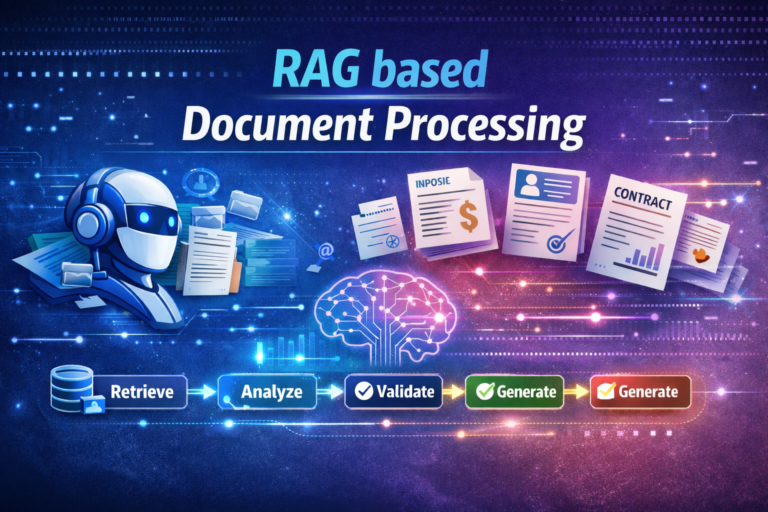
Putting It All Together: End-to-End RAG Flow
Let’s summarize the complete journey:
- Documents are ingested and cleaned
- Text is split into chunks
- Chunks are converted into embeddings
- Embeddings are stored in a vector database
- User submits a query
- Relevant chunks are retrieved
- Context is added to the prompt
- LLM generates the final answer
Each step plays a role in accuracy and reliability.
Why RAG Dramatically Reduces Hallucinations
RAG does not magically eliminate hallucinations, but it reduces them significantly because:
- The model is constrained by retrieved facts
- Answers are grounded in real data
- Context is explicit and verifiable
This is why RAG is widely adopted in enterprise AI systems.
Common Use Cases of RAG
RAG is used in:
- Enterprise knowledge assistants
- Customer support systems
- Policy and compliance tools
- Developer documentation search
- Legal and financial analysis
Anywhere you need trustworthy answers over private data, RAG is a strong choice.
Conclusion
Retrieval-Augmented Generation is a foundational pattern for building reliable AI systems. It combines the language capabilities of LLMs with the precision of retrieval systems.
Understanding RAG at an architectural level is essential before jumping into tools and frameworks. Once the concepts are clear, implementation becomes much easier.
In the next article, we will take this understanding and build a practical RAG system using LangChain, step by step.
Frequently Asked Questions (FAQs)
-
What is Retrieval-Augmented Generation (RAG)?
Retrieval-Augmented Generation (RAG) is an AI architecture that combines information retrieval with text generation. Instead of relying only on a language model’s internal training data, RAG first retrieves relevant information from an external knowledge source (like documents or databases) and then uses that information to generate a more accurate and grounded response.
-
Why is RAG needed when large language models are already powerful?
Large language models are powerful but have limitations:
1. They can hallucinate facts
2. Their knowledge is static (fixed at training time)
3. They cannot access private or enterprise dataRAG solves these problems by injecting fresh, relevant, and domain-specific information into the prompt before generation.
-
What are the main components of a RAG system?
A typical RAG system consists of:
Data Source – Documents, PDFs, web pages, or databases
Embedding Model – Converts text into vector representations
Vector Database – Stores and searches embeddings (e.g., FAISS, Pinecone)
Retriever – Finds relevant chunks based on query similarity
Large Language Model (LLM) – Generates the final answer using retrieved context -
What is the role of embeddings in RAG?
Embeddings convert text into numerical vectors that capture semantic meaning.
They allow the system to:
1. Find conceptually similar content
2. Retrieve relevant documents even if exact words differ
Good embeddings are critical for accurate retrieval in RAG systems. -
What types of use cases are best suited for RAG?
RAG is ideal for:
1. Enterprise knowledge assistants
2. Customer support bots
3. Legal and compliance systems
4. Technical documentation Q&A
5. Internal policy or HR chatbots
Any use case requiring accuracy over creativity benefits from RAG.



3 Comments