LangChain vs AutoGen for Agentic AI: What Has Changed in 2026
LangChain vs AutoGen is a comparison many developers encounter when they start building Agentic AI systems.
Both frameworks became important in the evolution of LLM-powered applications, but the landscape has changed significantly since the early days of agent frameworks.
LangChain has evolved into a broader framework for building LLM-powered applications and agents, while LangGraph provides lower-level orchestration capabilities for more complex, stateful agent workflows. AutoGen, meanwhile, introduced important patterns for multi-agent collaboration but is now in maintenance mode. Microsoft recommends its Microsoft Agent Framework for new projects and provides a migration path for existing AutoGen applications.
So the question in 2026 is no longer simply:
LangChain or AutoGen?
A better question is:
What type of Agentic AI system am I building, what level of orchestration control do I need, and which framework is appropriate for that architecture?
This article explores that question from an AI engineering and enterprise architecture perspective.
What Is an Agentic AI System?
A traditional LLM application often follows a relatively simple pattern:
User → Prompt → LLM → Response
A more sophisticated application may add retrieval and tools:
User → LLM → Retrieve Information / Call Tool → LLM → Response
An agentic system can go further by allowing an application to use an LLM to decide what actions to take, invoke tools, observe their results, and continue through multiple steps toward a goal.
A simplified agent loop can look like:
User Request
↓
Agent / LLM
↓
Determine Next Action
↓
Call Tool
↓
Observe Result
↓
Decide Next Step
↓
Complete Task
The important point is that an Agentic AI system is not defined simply by the use of an LLM.
It is an application architecture in which the model participates in decision-making and action execution within defined boundaries.
Not every LLM application needs an agent. If a deterministic workflow or a single model call can solve the problem reliably, adding an autonomous agent may introduce unnecessary complexity.
This is an important principle for enterprise AI architecture:
Use an agent when the problem benefits from dynamic decision-making and tool use. Use deterministic software when the workflow is already well defined.
Where Does LangChain Fit?
LangChain’s current documentation and project repository describes LangChain as a framework for building agents and LLM-powered applications.
LangChain provides abstractions and integrations for working with:
- Chat and language models
- Tools
- Retrievers
- Vector stores
- Embeddings
- Data sources
- Agent components
- Middleware
- Other LLM application components
Its ecosystem allows developers to connect models with external tools and data sources without implementing every integration from scratch.
A simplified LangChain-based application might look like:
User
↓
Agent
↓
LLM
↓
Tool Selection
↓
Tool / Retriever / API
↓
Result
↓
LLM
↓
Response
LangChain therefore provides a relatively high-level development experience for building LLM applications and agents.
Is LangChain Only for Agentic AI?
No.
This is an important distinction.
LangChain can be used for many types of LLM applications, including applications involving:
- Retrieval-Augmented Generation (RAG)
- Tool calling
- Structured outputs
- Model integrations
- Document processing
- Agent applications
- LLM workflows
Therefore, describing LangChain simply as an “Agentic AI framework” is too narrow.
It is better understood as a broader LLM and agent application framework.
Where Does LangGraph Fit?
This is one of the most important distinctions when comparing modern agent architectures.
LangGraph is a lower-level orchestration framework for building stateful, long-running agent workflows.
It provides mechanisms for representing workflows as graphs and managing things such as:
- State
- Nodes
- Transitions
- Conditional routing
- Loops
- Persistence
- Checkpoints
- Human-in-the-loop interactions
- Long-running execution
LangChain’s current project documentation explicitly positions LangGraph as the framework to consider when more advanced agent orchestration and control are required.
A simplified workflow could look like:
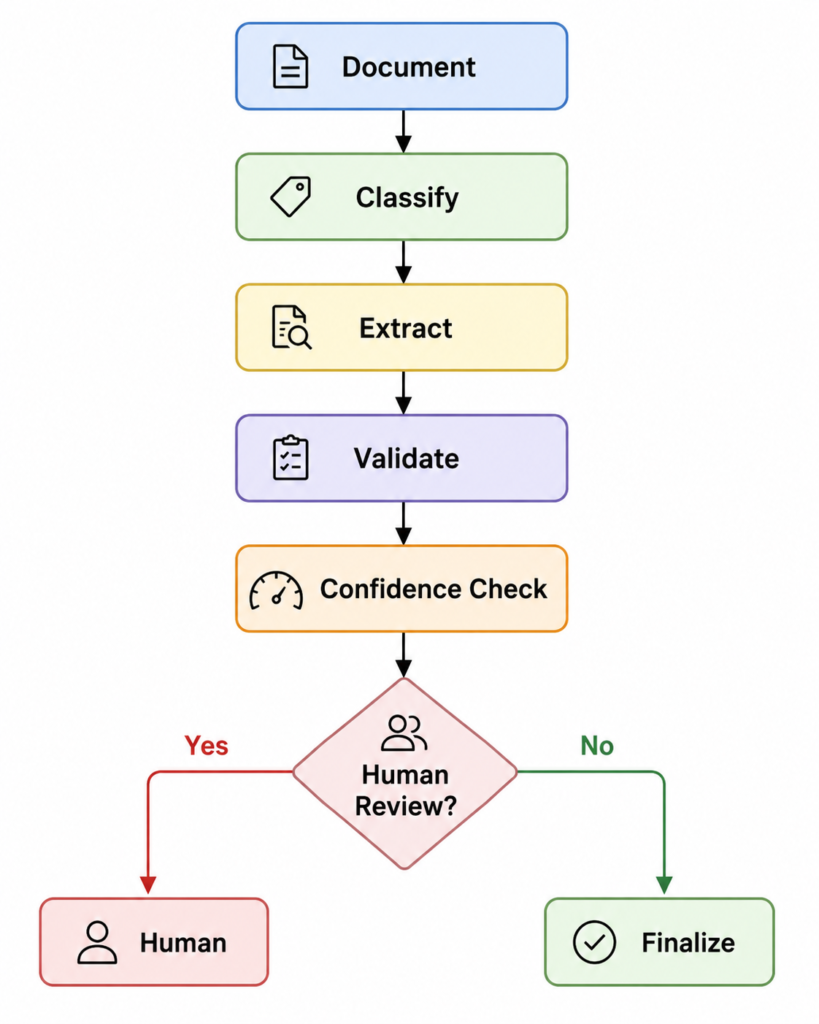
This is an example of where explicit workflow orchestration can be more appropriate than simply asking an LLM to decide everything.
LangChain and LangGraph Are Complementary
It is therefore misleading to think of LangChain and LangGraph simply as competitors.
A useful mental model is:
LangChain → Higher-level LLM and agent application framework
LangGraph → Lower-level orchestration and runtime for complex, stateful agent workflows
They can be used together.
For example, an application can use LangChain components for models and tools while using LangGraph to explicitly control the execution flow.
This separation is particularly useful for enterprise systems where we need both developer productivity and control over execution.
What Is AutoGen?
AutoGen was developed by Microsoft Research and became well known for its support for AI agents and multi-agent systems.
Its architecture supported agents communicating and collaborating to perform tasks.
For example, a software-development workflow could contain:
Planner
Break the requirement into smaller tasks.
Developer
Generate an implementation.
Reviewer
Review the implementation.
Executor
Run tests or execute the generated code.
The agents could then interact according to the orchestration pattern defined by the application.
AutoGen therefore played an important role in popularizing multi-agent application patterns such as collaborative agents and group conversations. Microsoft’s current migration documentation describes AutoGen as a framework for building AI agents and multi-agent systems and notes that it pioneered concepts such as GroupChat and event-driven agent runtimes.
AutoGen Is Not Simply “A Multi-Agent Framework”
The original version of this article described AutoGen as being primarily about multiple agents talking to each other.
That description is useful as an introduction, but it is incomplete.
AutoGen evolved beyond simple conversational examples and included a layered architecture with:
- Core runtime capabilities
- AgentChat abstractions
- Tools
- Single-agent patterns
- Multi-agent patterns
- Event-driven execution
Therefore, a more accurate description is:
AutoGen is a framework for building agent and multi-agent applications, with a strong emphasis on agent interaction and orchestration.
An Important 2026 Update: AutoGen Is in Maintenance Mode
AutoGen is now in maintenance mode.
Microsoft’s current AutoGen repository states that AutoGen will not receive new features or enhancements and is community managed going forward. Microsoft recommends that new users start with Microsoft Agent Framework, while existing AutoGen users are encouraged to migrate.
Microsoft Agent Framework is positioned as the successor to AutoGen and Semantic Kernel and combines agent abstractions with enterprise-oriented capabilities and graph-based workflows.
Therefore, if you are starting a new project in 2026, it would be misleading to present AutoGen as an equal default alternative to LangChain.
AutoGen is still relevant for:
- Understanding multi-agent architecture
- Existing AutoGen applications
- Learning from AutoGen’s architectural patterns
- Maintaining existing systems
- Evaluating migration to Microsoft Agent Framework
But for a new project, the framework decision should include Microsoft Agent Framework.
What Is Microsoft Agent Framework?
Microsoft Agent Framework is Microsoft’s current framework for building AI agents and workflows.
It combines concepts from AutoGen and Semantic Kernel and adds capabilities such as:
- Agent abstractions
- Session-based state
- Type-safe workflows
- Middleware
- Telemetry
- Tool integration
- Multi-agent orchestration
- Human-in-the-loop workflows
- Checkpointing
- Long-running workflows
Microsoft describes it as the direct successor to AutoGen and Semantic Kernel.
The framework supports both Python and .NET, making it particularly relevant for organizations with Microsoft-oriented enterprise technology stacks.
Its workflow model supports patterns such as sequential, concurrent, handoff and group collaboration.
LangChain vs AutoGen: What Has Actually Changed?
The original comparison between LangChain and AutoGen was useful when both were actively evolving frameworks.
In 2026, however, the comparison needs to be interpreted differently.
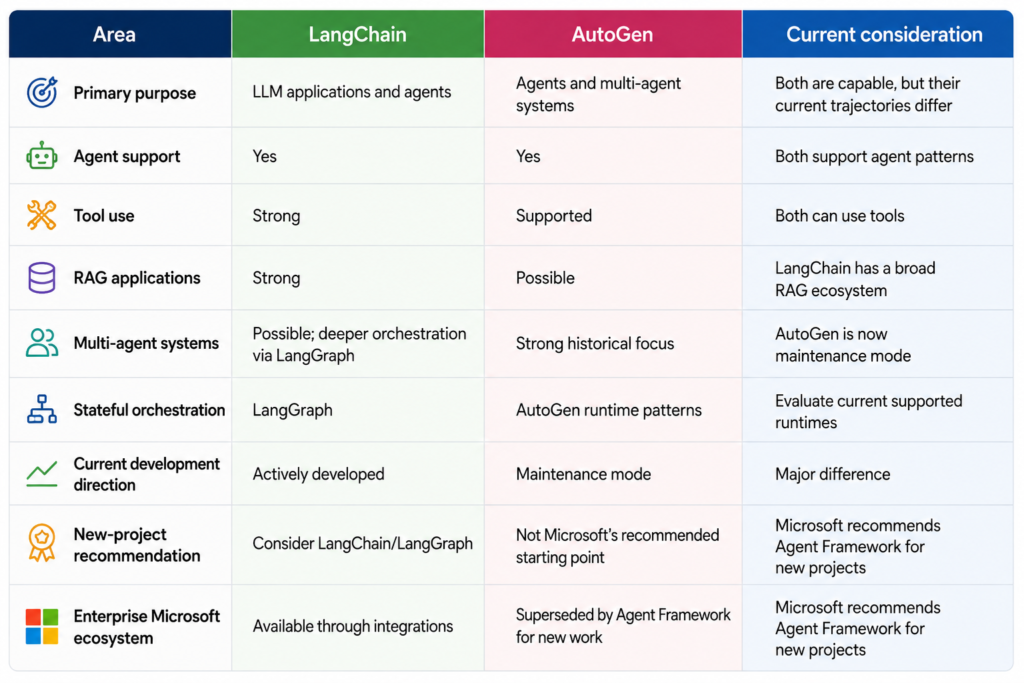
The most important difference is therefore not simply technical features.
It is the current development and ecosystem direction.
LangChain vs LangGraph vs Microsoft Agent Framework
For a new Agentic AI system in 2026, I would broaden the comparison.
LangChain
Consider LangChain when you need:
- A broad LLM application framework
- Model and tool integrations
- RAG capabilities
- Agent development
- Rapid experimentation
- A large ecosystem of integrations
LangChain is a good starting point when you want a higher-level development experience.
LangGraph
Consider LangGraph when you need:
- Explicit workflow control
- Stateful agents
- Branching
- Loops
- Long-running execution
- Persistence
- Checkpoints
- Human-in-the-loop workflows
- More control over agent orchestration
LangGraph is particularly relevant when the agent is becoming a complex production workflow rather than a simple tool-using assistant.
Microsoft Agent Framework
Consider Microsoft Agent Framework when:
- You are building new Microsoft-oriented agent applications.
- Your organization has strong .NET or Microsoft ecosystem expertise.
- You need Python and .NET support.
- You are migrating from AutoGen or Semantic Kernel.
- You need graph-based multi-agent workflows.
- Microsoft enterprise integration is an important consideration.
Microsoft currently positions Agent Framework as the successor to AutoGen and Semantic Kernel.
When Does AutoGen Still Make Sense?
AutoGen should not simply be treated as obsolete.
It remains relevant when:
1. You already have an AutoGen application
Migration has a cost.
An existing system may continue to operate while the team evaluates whether and when migration is justified.
2. You are learning multi-agent architecture
AutoGen’s concepts provide useful examples of agent collaboration and orchestration.
3. You are studying the evolution of Agentic AI
AutoGen has had an important influence on the development of multi-agent systems.
4. You are evaluating a migration
Microsoft provides an official AutoGen-to-Agent-Framework migration guide covering single-agent and multi-agent patterns.
For a completely new production application, however, I would evaluate the actively supported alternatives rather than starting with AutoGen simply because it was popular in earlier comparisons.
A Practical Enterprise Example
Consider an Intelligent Document Processing system.
The requirement is:
Extract information from a document, validate the extracted data, retrieve additional information when necessary, and send low-confidence cases to a human reviewer.
A possible architecture is:
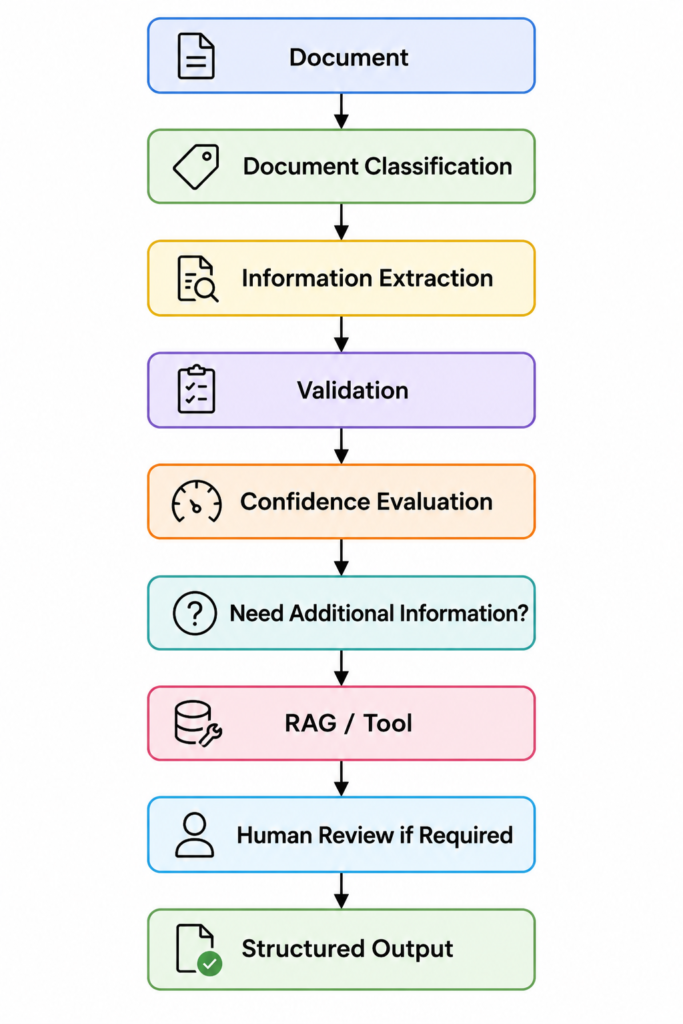
Notice that this is not necessarily a multi-agent problem.
Some stages can be deterministic.
Some can use an LLM.
Some may require retrieval.
Some may require human approval.
This leads to an important architectural principle:
Do not introduce multiple agents simply because a framework makes it possible.
Use agents where autonomous or dynamic decision-making adds measurable value.
For well-defined steps, conventional software may be more predictable, cheaper and easier to test.
Microsoft’s current Agent Framework guidance makes a similar distinction: use an agent for open-ended tasks requiring autonomous tool use and planning, while workflows are better suited to well-defined steps requiring explicit execution control.
A Better Framework Selection Process
Rather than starting with:
“Which framework is best?”
I recommend the following process.
Step 1: Define the business problem
What are you actually trying to automate?
Don’t start with the framework.
Start with the business outcome.
Step 2: Determine whether an agent is required
Ask:
- Is the workflow predictable?
- Can conventional code solve it?
- Does the system need dynamic decisions?
- Does the system need tool selection?
- Does the system need iterative reasoning?
If conventional software solves the problem well, an agent may not be necessary.
Step 3: Identify the orchestration requirements
Ask whether the system needs:
- State
- Persistence
- Conditional routing
- Loops
- Parallel execution
- Multiple agents
- Human approval
- Long-running execution
The more control you need, the more important the orchestration layer becomes.
Step 4: Choose the appropriate abstraction
A simple application may require only an LLM SDK.
A more sophisticated application may benefit from LangChain.
A complex stateful agent workflow may benefit from LangGraph.
A Microsoft-oriented enterprise system may make Microsoft Agent Framework an attractive option.
The framework should follow the architecture.
Not the other way around.
My Recommendation
If I were evaluating an Agentic AI application today, I would use the following decision process.
Simple LLM application
LLM SDK
Use direct model APIs when the application does not require agent orchestration.
RAG or tool-using application
LangChain or another suitable application framework
Use a higher-level framework when you need integrations, retrieval and tool abstractions.
Complex stateful Agentic AI workflow
LangGraph or Microsoft Agent Framework
Use an explicit orchestration framework when you need state, branching, loops, persistence, human intervention or multi-agent coordination.
Existing AutoGen application
Evaluate whether migration is justified
Don’t rewrite a working system simply because the technology landscape has changed. Evaluate business value, technical debt, operational requirements and migration effort.
New Microsoft-oriented enterprise project
Evaluate Microsoft Agent Framework
It is Microsoft’s current successor to AutoGen and Semantic Kernel for agent and workflow development.
The Bigger Lesson for AI Engineers
The most important lesson is that framework knowledge alone does not make someone an AI architect.
Knowing how to call an LLM is useful.
Knowing how to create an agent is useful.
Knowing LangChain, LangGraph or Microsoft Agent Framework is useful.
But enterprise AI architecture requires a broader set of decisions.
You need to understand:
- When to use an LLM
- When not to use an LLM
- When RAG is appropriate
- When an agent adds value
- When deterministic code is better
- How to control agent behavior
- How to evaluate AI output
- How to handle failures
- How to manage latency
- How to control cost
- How to secure tools and data
- How to introduce human oversight
- How to monitor production behavior
The framework is only one part of that architecture.
The more valuable skill is being able to map:
Business Problem
↓
AI Capability
↓
Architecture
↓
Orchestration
↓
Technology Choice
↓
Evaluation & Observability
↓
Production System
Final Thoughts
The LangChain vs AutoGen comparison remains useful for understanding how the Agentic AI ecosystem evolved, but the technology landscape has changed considerably.
LangChain is currently a broader framework for building LLM-powered applications and agents, while LangGraph provides lower-level orchestration for complex, stateful agent workflows.
AutoGen played an important role in the development of multi-agent systems, but it is now in maintenance mode. Microsoft recommends Microsoft Agent Framework for new projects and provides migration guidance for existing AutoGen applications.
Therefore, in 2026, I would not approach the decision simply as:
LangChain vs AutoGen
Instead, I would ask:
What problem am I solving, how much agentic behavior do I actually need, how much control do I need over execution, and which actively supported framework best fits that architecture?
That is the mindset that takes an engineer from building AI demos to designing enterprise AI systems.